
Spirit of Tasmania Terminal 3 Marine Construction | Total Dive Solutions
Commercial Diving at the Spirit of Tasmania Terminal 3 Redevelopment, Devonport
Total Dive Solutions has provided specialist commercial diving, marine construction and vessel support services during the redevelopment of the Spirit of Tasmania Terminal 3 at the Port of Devonport.
The project has required the coordination of major civil, structural and marine construction activities within an operational Tasmanian port. For Total Dive Solutions, the scope extended well beyond conventional commercial diving and included seabed preparation, geofabric installation, rock bag placement, pile protection, marine hardware installation, hydrographic survey support, workboat operations, tug operations and local logistical support.
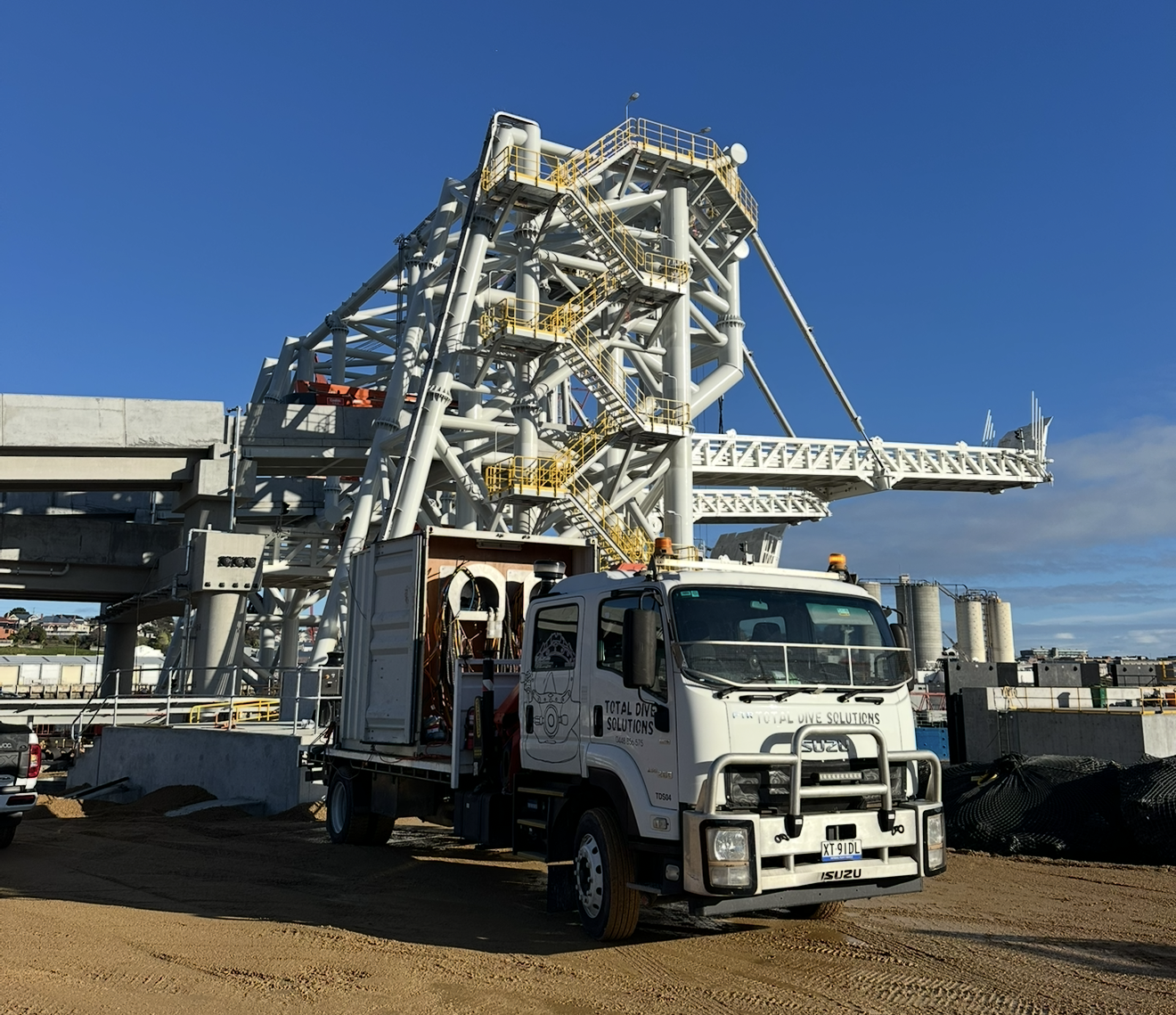
Total Dive Solutions on site at TT Line Terminal Redevlopment - Land Setup on TDS Vehicle 4 MR Truck
Working from our Devonport base, Total Dive Solutions was able to provide marine personnel, commercial dive teams, vessels and local project support across a number of separate work fronts as construction progressed.
The project demonstrates the role a capable local marine contractor can play in supporting major infrastructure projects where underwater construction, vessel operations, survey control and surface construction activities need to operate as one coordinated system.
Seabed preparation and targeted underwater dredging
Accurate seabed preparation was required in nominated areas before subsequent marine construction activities could proceed.
Total Dive Solutions completed targeted dredging of the seabed to achieve the required depths and profiles within defined work areas.
Unlike large-scale capital dredging, targeted construction dredging requires close control of the excavation area. The objective is to remove material where required by the design while limiting unnecessary disturbance outside the nominated footprint.
Our dive teams worked directly within the target areas to identify the existing seabed level, remove material and progressively prepare the seabed for subsequent construction activities.
A critical part of this process was coordination with the project hydrographic surveyor.
Rather than treating dredging and survey as separate activities, the work was undertaken as an iterative process. Areas were dredged, surveyed and reviewed against the required design levels. Where additional material needed to be removed, the dive team could return directly to the nominated locations.
This approach provided the construction team with a controlled method of achieving the required seabed levels while allowing survey information to guide subsequent underwater works.
For marine infrastructure projects, this interface between commercial divers and hydrographic surveyors is particularly important. The survey establishes the measurable seabed condition, while the dive team provides the physical capability to inspect, expose, excavate and prepare specific underwater locations.
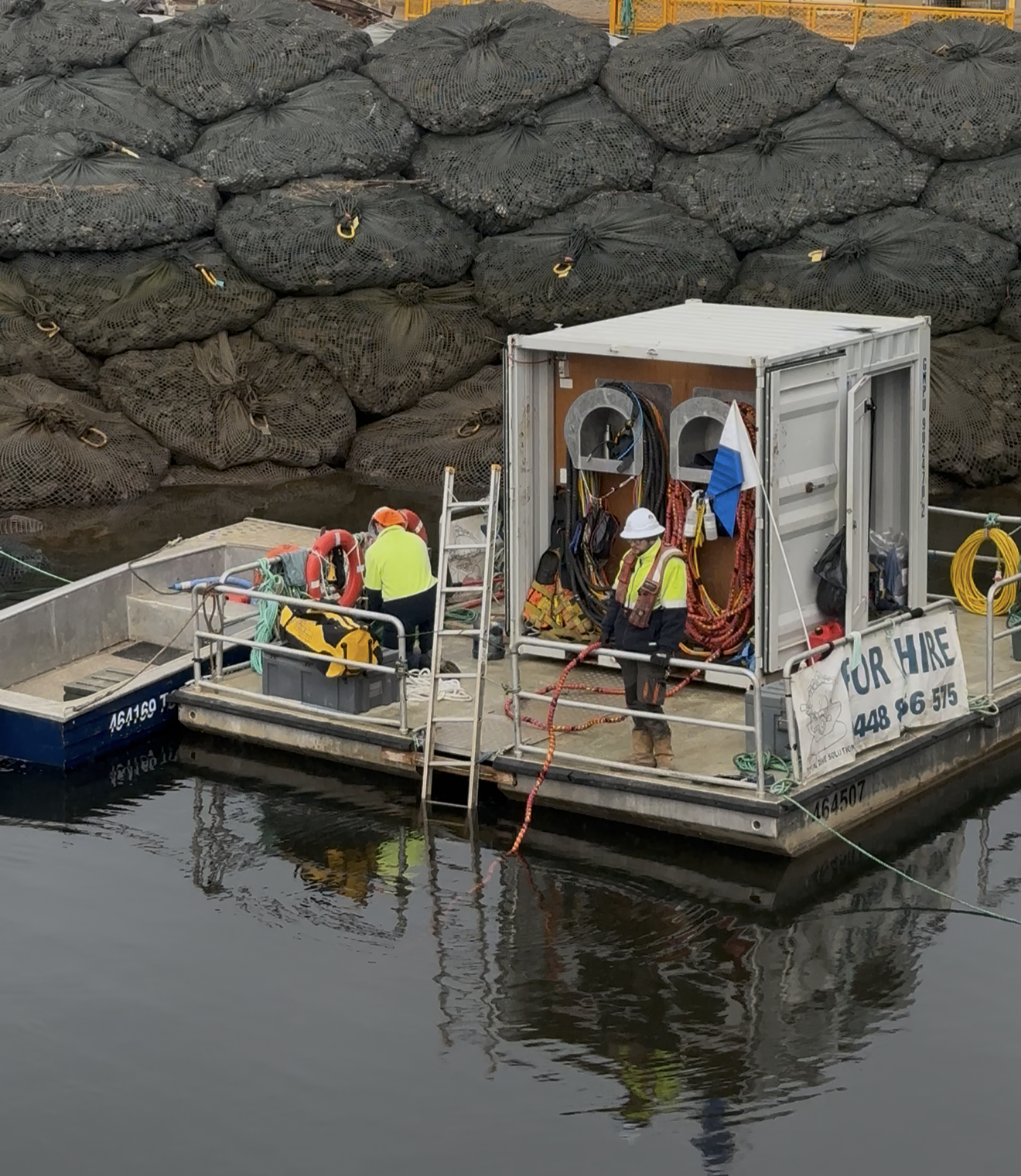
A TDS Dive Spread on paired barges “Lilly” and “Tom” Onsite
Geofabric installation for subsea construction
Total Dive Solutions also completed underwater installation of geofabric within the marine construction area.
Geofabric, or geotextile, is commonly used as part of engineered seabed and scour protection systems to provide separation and filtration between the natural seabed and material installed above it.
Underwater installation requires significantly more control than placing geofabric in a dry construction environment.
Once submerged, the material is affected by water movement, trapped air, lifting arrangements and the condition of the underlying seabed. Poorly controlled placement can result in folds, displacement or sections of fabric being incorrectly positioned before the next construction layer is installed.
Our divers were responsible for positioning and managing the geofabric underwater so that it followed the required construction footprint and provided a suitable foundation for the following works.
The activity required coordination between the dive supervisor, divers, lifting plant and surface construction personnel. Communication was particularly important during lowering and positioning, as the surface operator has limited visibility of the final installation area.
The diver therefore becomes an important part of the lifting and installation process, providing real-time information to the surface team and controlling the final subsea position.
Rock bag placement and scour protection works
Following seabed preparation and geofabric installation, Total Dive Solutions supported the placement of engineered rock bags within the works.
Rock bags provide a controlled method of placing aggregate in defined underwater locations and are commonly incorporated into scour protection, erosion protection and subsea stabilisation systems.
Although a crane or other surface lifting plant provides the primary lifting capability, precise final positioning is dependent on underwater guidance.
Our commercial divers worked with the lifting teams to guide individual rock bags into the required location, manage clearances and confirm their final position on the seabed.
This requires disciplined communication between the diver, dive supervisor and crane operator.
The diver must remain clear of suspended loads and potential crush zones while still maintaining sufficient visibility or physical reference to guide the load accurately into position.
Once the load reaches the final installation area, the diver can confirm orientation, interface with previously installed materials and placement against the required construction footprint.
The work is representative of the type of diver-assisted lifting operation regularly required during wharf construction, scour remediation, pipeline protection and other marine civil projects.
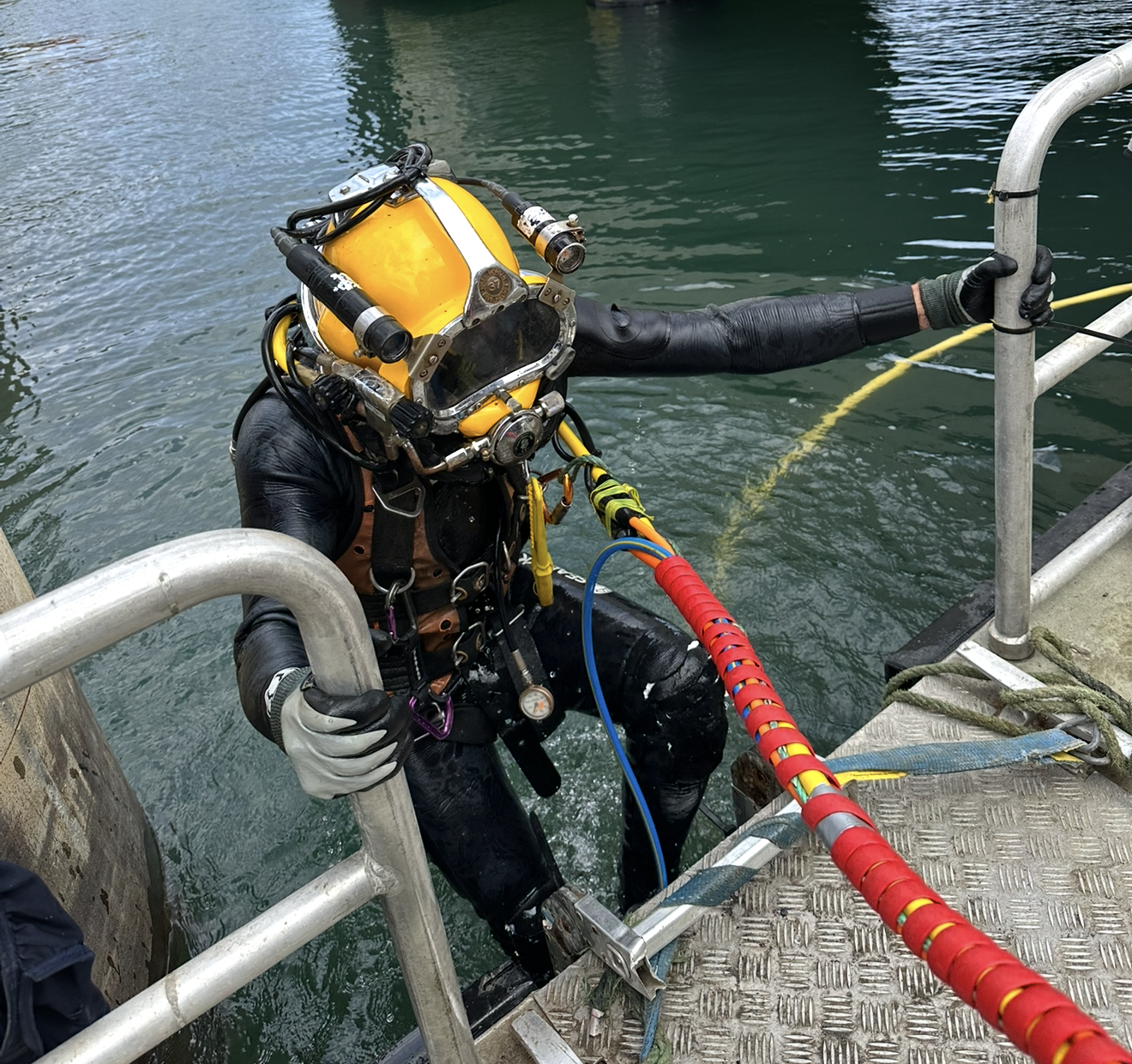
TDS Crew in the water and on the job - Working hard!
Pile wrapping using the Series 2000 pile protection system
Pile protection formed another component of Total Dive Solutions' work at the Terminal 3 redevelopment.
TDS completed pile wrapping using the specified UCC Series 2000 pile protection system.
Marine piles operate in one of the most aggressive environments for structural materials. The submerged, tidal and splash zones create different corrosion conditions, while abrasion, marine growth and physical impact can further affect the condition of the pile.
A correctly installed pile protection system provides an additional barrier between the existing pile and the surrounding marine environment.
For the Terminal 3 works, the process required controlled preparation of the pile surface followed by installation of the specified protection system in accordance with project and product requirements.
Underwater pile wrapping is a detailed task.
The installation must follow the pile profile, maintain the required coverage and provide a consistent protective system through the nominated section of the pile. Divers need to work progressively around the pile while managing tools, materials and their own umbilicals within a restricted work area.
Following installation, the completed system was visually checked to confirm the required coverage and installation condition.
Total Dive Solutions has substantial experience in pile inspection, preparation, remediation and pile wrapping within Tasmanian ports and marine structures. This capability allows our teams to undertake both isolated pile repairs and larger programmed pile remediation campaigns.
Vessel support for engineering and underwater inspections
Marine infrastructure projects frequently require engineers, surveyors, inspectors and other specialists to access structures from the water.
Total Dive Solutions provided small workboat support for inspection activities associated with the Devonport works.
Using locally available commercial workboats allowed inspection personnel and equipment to be transferred and positioned efficiently around the marine construction area.
Small vessel operations can appear to be a relatively simple component of a large construction project, but reliable vessel support has a direct impact on productivity.
The vessel operator must understand the work area, vessel traffic, tidal conditions, construction plant movements and the requirements of the inspection team.
For underwater and over-water inspections, vessel positioning also needs to allow personnel to obtain the information required without interfering with other construction activities.
By supplying both marine construction and vessel capability, TDS could support inspection teams without requiring a separate marine contractor to be mobilised for each activity.
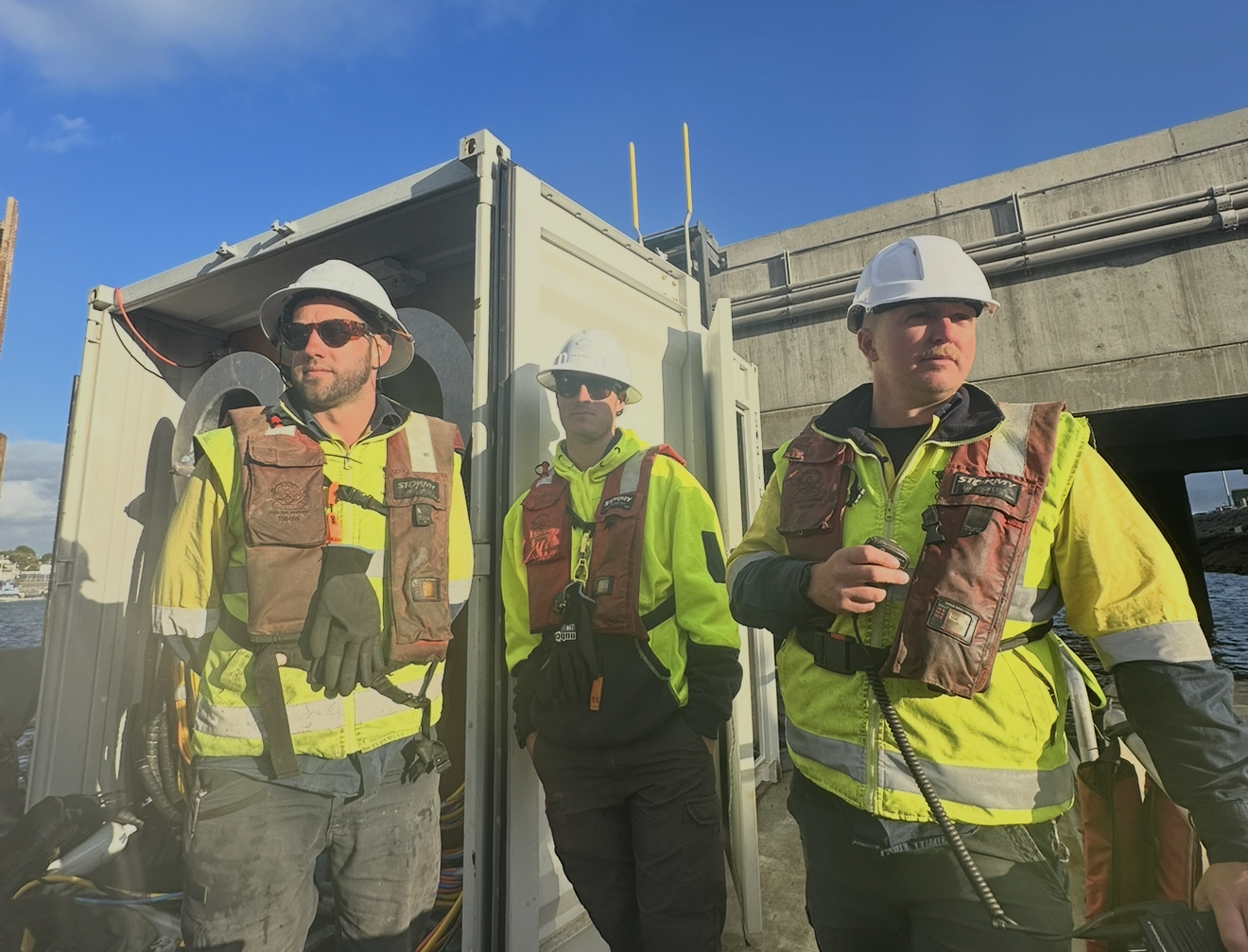
Few of the crew on the job - all supervising of course
Coordination with hydrographic surveyors
Hydrographic survey information was an important control during the seabed preparation works.
TDS worked with hydrographic survey personnel to identify areas requiring further seabed modification and to verify that completed areas had reached the required construction depth.
This created a direct feedback loop between survey and construction.
Survey data identified the areas requiring attention. The dive team then undertook the physical seabed preparation before the area was resurveyed.
For project engineers, this process provides a more controlled method of managing underwater earthworks because progress is based on measurable survey data rather than diver estimation alone.
It also reduces unnecessary dredging by allowing the dive team to concentrate on defined high areas or isolated locations requiring further excavation.
The ability to coordinate commercial diving and hydrographic survey operations is particularly valuable on marine construction projects where seabed tolerances affect the installation of scour protection, precast elements, pipelines, mattresses, foundations or other subsea infrastructure.
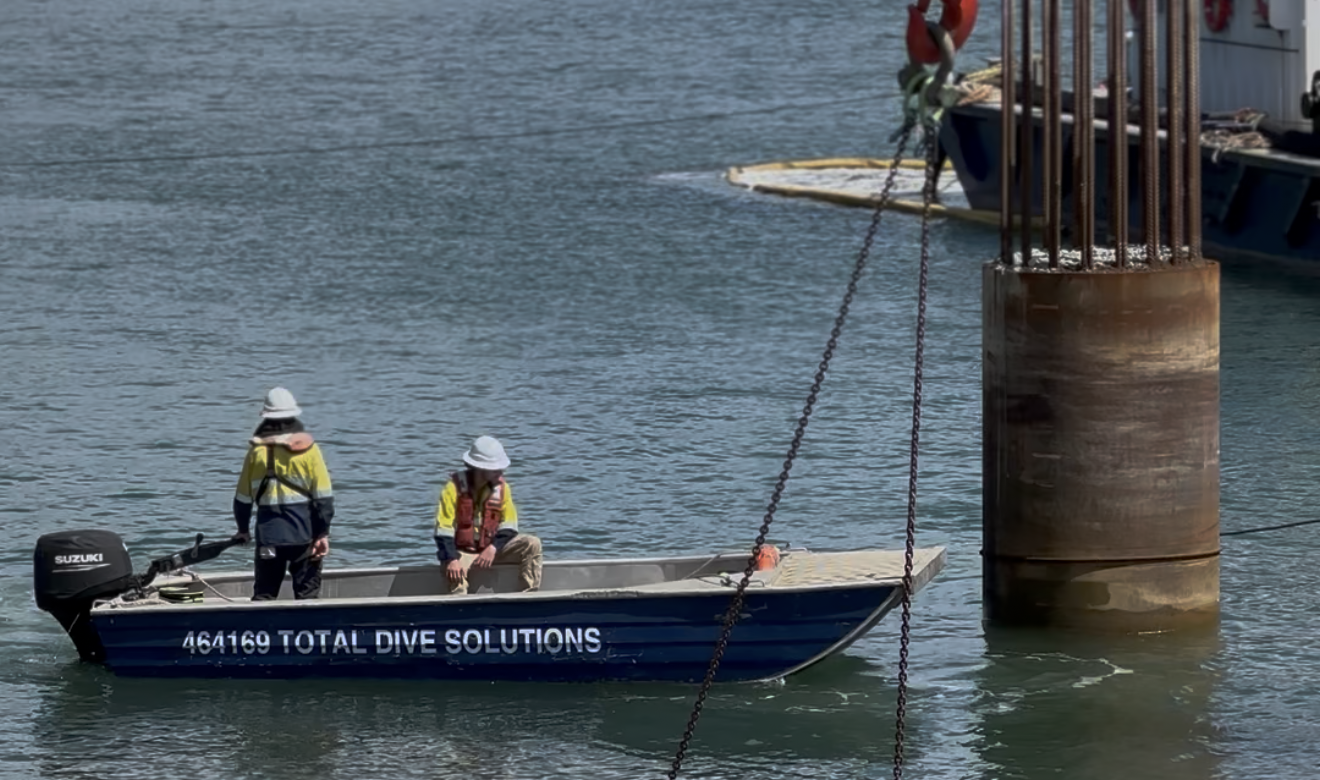
TDS Qualified skippers onsite supporting the marine crews.
Marine hardware installation
Total Dive Solutions also completed the installation of marine hardware associated with the redevelopment.
Underwater hardware installation requires the diver to translate engineering drawings and surface measurements into a physical installation in an environment where visibility and access can be limited.
Depending on the component and location, the work can involve positioning, alignment, fastening, adjustment and final verification of items attached to marine structures.
Successful installation relies on preparation before the diver enters the water.
Hardware, tooling and installation sequences need to be understood by the dive team, with components prepared so unnecessary underwater handling is minimised.
Where components are lowered from the surface, the diver also needs to coordinate closely with lifting personnel to guide the item through the final stages of installation.
TDS approaches this type of work as an underwater construction activity rather than simply a diving task. The objective is to install the component in accordance with the construction requirements and provide the surface project team with clear confirmation of the completed work.
Tug operations and barge movements
The marine construction program also required barge movements within the project area.
Total Dive Solutions provided qualified tug vessel driving and marine personnel to assist with barge movements.
Moving construction barges requires an understanding of the barge characteristics, available water depth, current, wind, nearby structures, construction plant and other vessel movements.
The operation becomes more complex within an active port where marine construction activities need to remain coordinated with commercial vessel traffic and other contractors.
TDS personnel worked with the project teams to reposition barges as required to support changing construction activities.
Having experienced local vessel operators available as part of the broader marine team reduced the number of interfaces required to undertake routine barge movements and allowed marine plant to be repositioned as construction priorities changed.
Local marine support for mainland contractors
Major Tasmanian infrastructure projects regularly involve specialist contractors, engineers and construction personnel mobilising from mainland Australia.
One of the practical challenges for these contractors is establishing reliable local marine capability once they arrive in Tasmania.
Total Dive Solutions provided local contact and project support to mainland contractors working on the Terminal 3 redevelopment.
This included access to local personnel, commercial diving capability, vessels, marine equipment and knowledge of operating within the Port of Devonport.
Local capability can significantly reduce the amount of equipment and personnel that needs to be mobilised interstate.
It also gives project teams access to personnel who understand local suppliers, marine conditions, port operations and the practical requirements of delivering work in Tasmania.
For contractors undertaking short-duration specialist scopes, having an established local marine contractor can be particularly useful. Rather than establishing an entire marine operation for a limited package of works, specialist contractors can integrate with an existing local capability.
For longer projects, the same relationship provides continuity as mainland personnel rotate through the site or different stages of construction commence.
Integrated marine construction capability in Devonport
The Terminal 3 works demonstrate the advantage of combining commercial diving and marine services within the same local delivery team.
During the project, Total Dive Solutions' scope included:
• Commercial construction diving
• Targeted underwater dredging and seabed preparation
• Coordination with hydrographic surveyors
• Geofabric and geotextile installation
• Rock bag placement
• Scour protection installation support
• Series 2000 pile wrapping and pile protection
• Marine hardware installation
• Small workboat and inspection vessel support
• Tug vessel operation
• Construction barge movements
• Local logistical and contractor support
This combination allows TDS to support a marine project across several stages without each underwater or vessel activity requiring an entirely separate contractor.
For engineers and project managers, reducing interfaces is particularly valuable on marine construction projects.
Underwater works are often directly connected to survey, lifting, piling, dredging, structural installation and vessel activities. Delays in one discipline can quickly affect the next stage of construction.
A marine contractor capable of working across these interfaces can help project teams resolve issues at the workface rather than treating each activity as an isolated scope.
Commercial diving and marine construction capability across Tasmania
Total Dive Solutions is a Tasmanian commercial diving and marine construction contractor with operational bases in Devonport and Hobart.
Our teams support principal contractors, engineering companies, port authorities, asset owners and specialist subcontractors across marine civil construction, underwater inspection, pile remediation, vessel support and subsea installation projects.
TDS operates commercial diving activities in accordance with AS/NZS 2299.1 and maintains ISO 9001 Quality Management, ISO 45001 Occupational Health and Safety and ISO 14001 Environmental Management systems.
Our marine construction capabilities include pile inspection and remediation, pile wrapping, underwater cutting and welding, scour protection, geofabric installation, rock placement, subsea hardware installation, pipeline works, dredging support, hydrographic survey support, wharf maintenance and vessel operations.
With locally based commercial dive teams, workboats, vessels, mobile dive systems and marine construction equipment, TDS can support projects throughout Tasmania while also providing an established local delivery partner for interstate contractors mobilising to the state.
The Spirit of Tasmania Terminal 3 redevelopment at Devonport is a strong example of this integrated delivery model.
Rather than providing a single isolated diving service, Total Dive Solutions has supported multiple marine construction activities across the project, from preparing the seabed through to installing permanent infrastructure and supporting the vessels, barges, surveyors and contractors required to deliver the works.
For engineering and construction teams planning marine infrastructure works in Devonport or elsewhere in Tasmania, Total Dive Solutions provides a single local point of contact for commercial diving, underwater construction and marine support services.
Contact Total Dive Solutions to discuss commercial diving or marine construction support for projects in Devonport, Hobart or anywhere across Tasmania.
Marine construction Tasmania
Commercial diving Devonport
Commercial diving Tasmania
Underwater construction Tasmania
Spirit of Tasmania Terminal 3
Devonport Berth 3 marine construction
Pile wrapping Tasmania
UCC Series 2000 pile wrapping
Rock bag installation
Geofabric installation
Subsea dredging
Underwater dredging Tasmania
Hydrographic survey support
Marine construction diving
Marine hardware installation
Workboat support Tasmania
Tug and barge support
Port of Devonport marine contractors